Explore the effectiveness of gamification and different group settings on students’ learning outcomes in teaching higher education computer science courses.
Explore the effect of gamification and group size on students’ satisfaction level.
Assess the effectiveness of gamification and different group sizes on learning outcomes and students’ satisfaction over time through longitudinal experiments.
Theoretical Frameworks
Nah’s gamification framework.
Goal Orientation
Achievements
Reinforcements
Competition
Fun Orientation
Type of Research & Variables Studied
Quantitative
Group size
Satisfaction levels
Game design elements
Instruments & Measures
Learning objectives
Group size
Satisfaction levels through questionnaire
Comments
No gameplay or story or any other “game” elements.
Results were generally positive.
Students in the gamification groups all had better grades across the board.
Students were more satisfied in the no group and small group settings.
Strong correlation between the students mark and their satisfaction.
[@ibanez2014]
Topic & Problem
Student engagement and academic performance.
Research Questions
To explore the impact of gamification on students’ engagement.
To gain understanding about students’ engagement through students’ reports and interactions with the gamified platform.
To measure the impact of gamification on student academic performance.
Theoretical Frameworks
Lazzaro identifies four keys to unlocking players’ emotions: 1) providing opportunities for challenge, strategy, and problem solving (hard fun); 2) introducing elements that foster mystery, intrigue, and curiosity (easy fun); 3) leading players to excitement or relief moods (altered states); and 4) promoting competition and teamwork (people fun).
The taxonomy also states the need to provide feedback and information about progress as well as the social and competitive elements necessary to promote learners’ engagement.
Type of Research & Variables Studied
Mixed methods
sensation, fantasy, narrative, challenge, fellowship, discovery, expression, and submission.
Instruments & Measures
Pre and post test questionnaires to measure knowledge acquisition.
Open-ended questionnaire to measure preferences and motivations.
Non-parametric Wilcoxon signed-rank test.
Parametric t-test.
Comments
Good example of mixed methods in action.
They did not distinguish between intrinsic vs. extrinsic motivation and acknowledged more research needs to be done here.
Check out the Petrovic article for taxonomy about gamification satisfaction metrics.
[@goshevski2017]
Topic & Problem
Student motivation.
Research Questions
How do different gamification platforms improve people’s motivation?
Theoretical Frameworks
Werbach and Hunter present game design elements as pyramidal hierarchy composed of three layers: components, mechanics and dynamics.
Becker and Nicholson present two types of gamification for managing classrooms: reward-based and meaningful.
Type of Research & Variables Studied
Quantitative
Instruments & Measures
Components, mechanics and dynamics.
Reward-based and meaningful.
Class Craft, Kahoot, Rezzly, Seppo, Youtopia.
Comments
How can you have a leaderboard without names?
Kahoots can get boring after a while.
Must consider teacher’s time since it takes a while to set up games.
[@iosup2014]
Topic & Problem
Student engagement.
Student motivation.
Research Questions
Can gamification be effective in teaching higher-education courses?
Theoretical Frameworks
Bartle’s taxonomy for player motivation: explorers, achievers, socializers, winners.
Zichermann and Cunningham’s framework for core tools of gamification: point systems, levels, leaderboards, badges, onboarding, social engagement, unlocking content.
Type of Research & Variables Studied
Quantitative
Passing rates
Participation
Satisfaction
Instruments & Measures
Official surveys
Volunteered testimonials
In-class participation
Comments
I think this is like that other study where it’s just assessments that have a point to grade mapping, there’s no actual game being played from what I can gather.
Challenge: Lots of teacher time investment is required.
[@li2013]
Topic & Problem
Student engagement.
Effectiveness of game platform.
Research Questions
How to better engage the students in PeerSpace social and learning activities?
Participate more in social and learning activities
Develop a stronger sense of community
Be more willing to help each other on academic and social matters.
Theoretical Frameworks
Participation points, a level system based on participation points, a progress bar, leader boards, collaborative programming for community building, and casual games
Type of Research & Variables Studied
Quantitative
Instruments & Measures
Experimental group used the game features, the control group did not.
The number of posts created by each group over a 6 week period was compared and analyzed.
Comments
This platform sounds like exactly what I would want to use in my classroom.
Upon further research, it seems closed source. Might have to reach out to the authors.
[@indriasari2020a]
Topic & Problem
Peer review.
Quality of feedback.
Research Questions
How have peer review activities been gamified?
What actions have been gamified?
What methods have been used to gamify the actions?
What game elements have been used?
In which contexts (course/subject) and levels (year of study) have peer review been gamified?
What is the evidence and impact of the gamified peer review studies?
Theoretical Frameworks
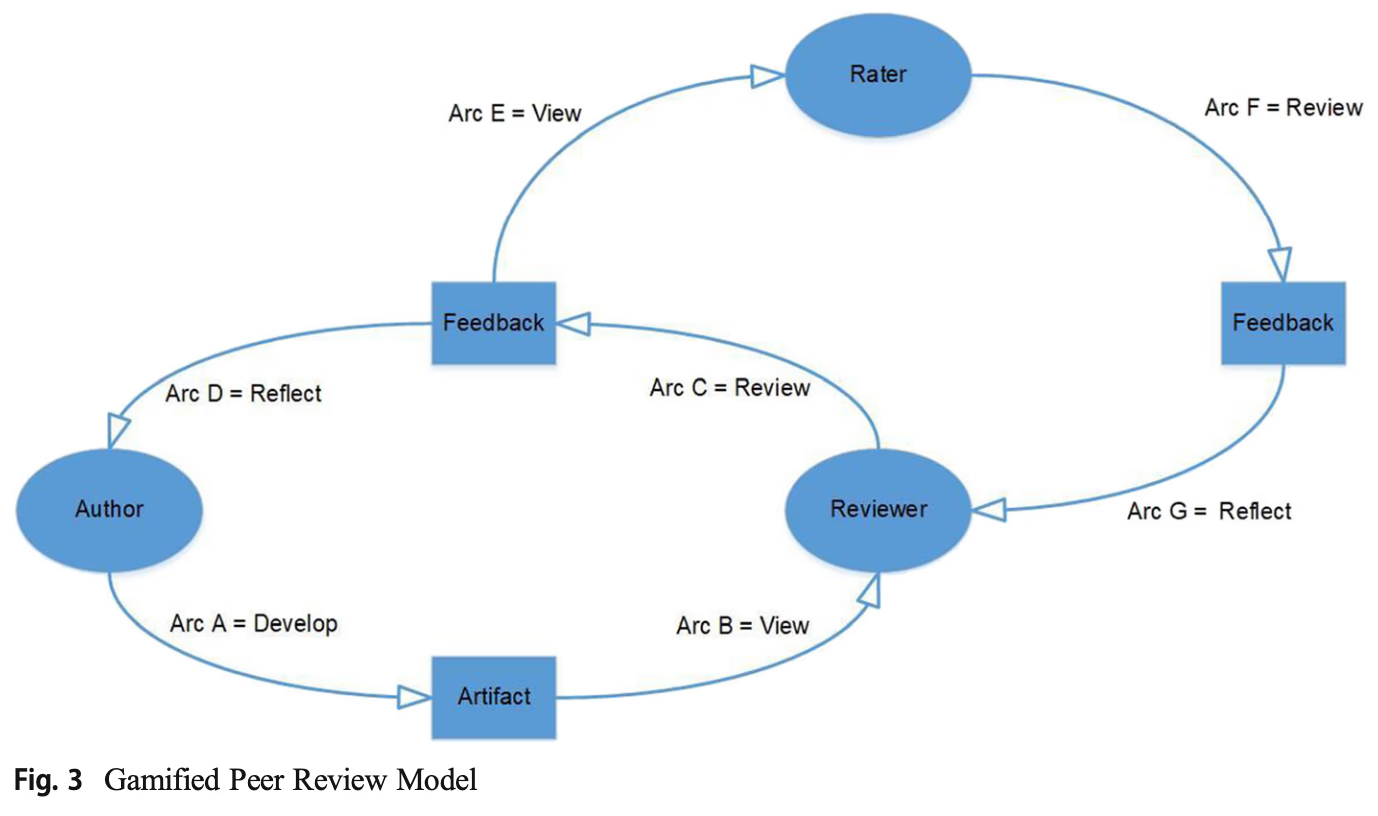
It captures the activities that may occur during a student peer review process. The circular nodes represent the different roles that students adopt. The rectangular nodes symbolize objects. The arcs represent actions taken by students, mediated through the peer review system.
Type of Research & Variables Studied
I think this is quantitative since they’re not doing any surveys? It’s all about coding attributes from several articles and analyzing the trends.
Engagement, Contentment, Correlation between peer review activities and performance, Correlation between the difficulty of activity and reward, Creation of learning communities, Performance.
Comments
Is this what they call a meta-analysis?
Automated vs manual reward allocation reminds me of the gam “Paper, Please?”
Using an LLM to assess the quality of feedback must be so trivial these days with AI. Something to look into.
Authors mention further research on the gamification of tasks involving peer review of source code is warranted.
[@llorens-largo2016]
Topic & Problem
Gamification effectiveness.
Research Questions
What makes an effective gamification approach of a course?
Theoretical Frameworks
Simplicity, feedback, real time, progress, autonomy, responsibility, treatment of error.
Spoiler alert: the games actually have to be fun to work.
I’m not sure if this was actually a “study” of anything? It was hard to deduce what the actual experiment was and what they were measuring exactly.
[@indriasari2023]
Topic & Problem
Student peer feedback quality.
Research Questions
How does gamification impact the quality of written feedback?
How do students perceive the value of feedback produced and received?
What is the impact of gamification on the quality of student code reviews?
Theoretical Frameworks
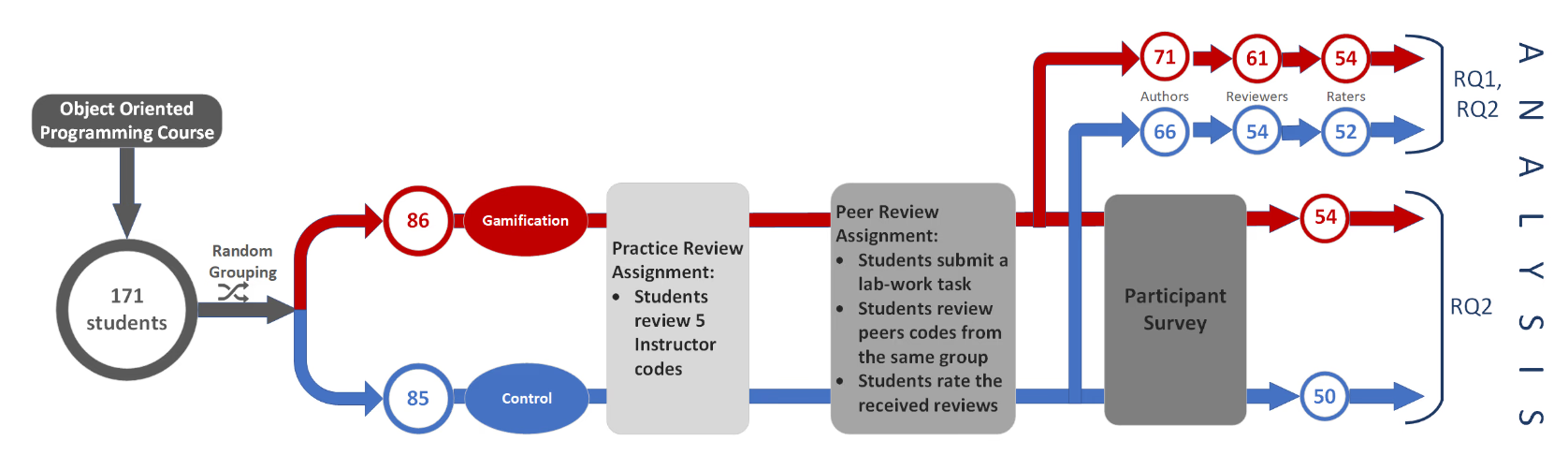
Activities are shown in different colour of grey box and participants counts are shown in red circle for gamification condition and blue circle for the control condition.
Type of Research & Variables Studied
Quantitative.
Variables names.
Expressions.
Control flow.
Comments.
Layout.
Decomposition.
Modularization.
Instruments & Measures
The survey included two Likert-scale questions and an open-ended question, as follows:
SQ1. “Overall, I found that the feedback that I received was useful to me.”
SQ2. “Overall, I think the feedback that I provided would be useful for my peers.”
SQ3. “Please comment on the quality of feedback you read during peer code review.”
Comments
Low motivation has been linked to substandard review quality. This makes the review process a great place to try gamification!
The authors mention that exploring a more sophisticated game design would beneficial to research. Perhaps I would want to look into this, but creating more complex games will take a ton of time.
[@butler2016]
Topic & Problem
High attrition rate for Computer Science students.
Student motivation.
Research Questions
How to develop engaging and interactive learning games based on the needs of CS students?
Theoretical Frameworks
Constructivist model.
Besides that, I don’t think there is any mention of a formal model or framework.
Type of Research & Variables Studied
Quantitative.
Instruments & Measures
Questionnaire of 15 questions administered after the students played the learning game.
The less the game seems like an “education game” and more like an actual game, the more likely students are to engage. This is challenging though because creating a game takes a lot of resources.
[@oktaviati2018]
Topic & Problem
Different aspects of gamification.
Research Questions
Analyze the existing research to find common gamification elements that are used in classrooms, the impact of gamification on motivation and engagement in learning.
Theoretical Frameworks
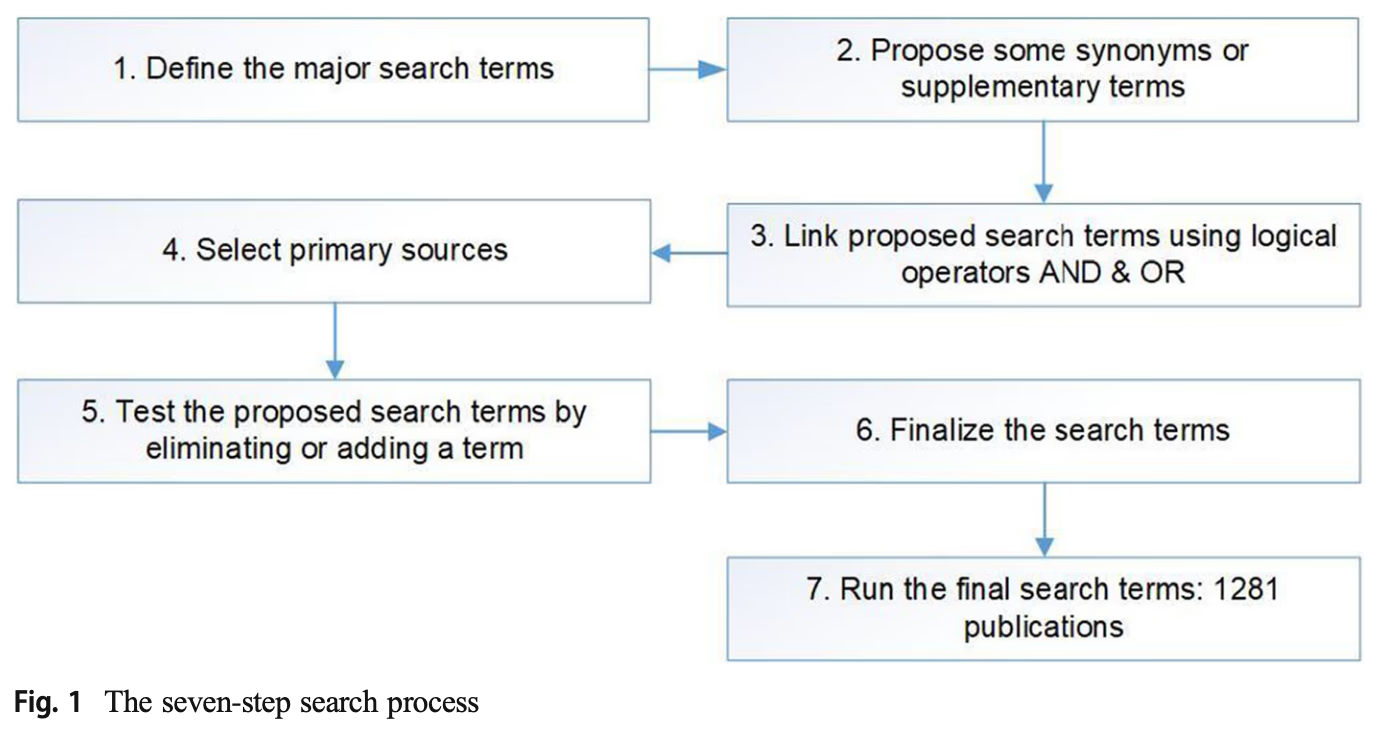
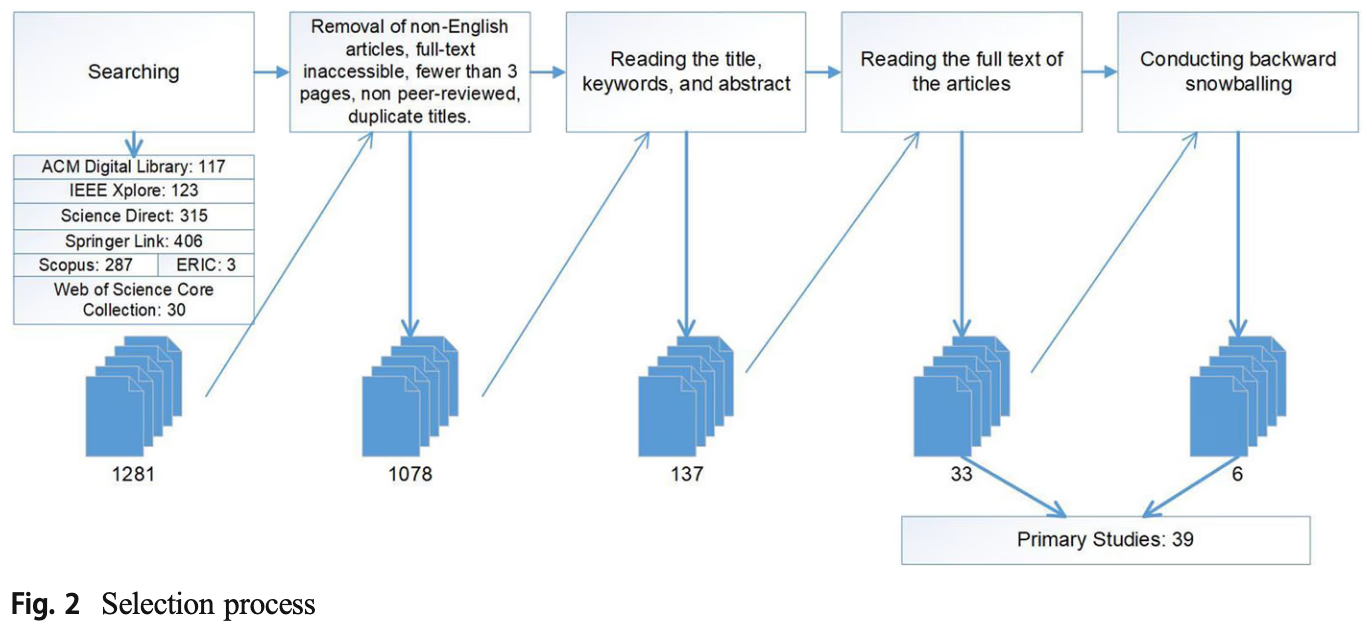
Could not find a framework per se, but they did outline the process of finding articles and how they picked their keywords.
The authors categorized the articles using these categories: Source of the articles, type of research, number of participants, course, and demographics.
Type of Research & Variables Studied
Qualitative meta-analysis.
Instruments & Measures
Whether the article mentioned any of: Badges, points, levels, leaderboards, tasks, timers, countdowns, avatars, trophies, challenges, storylines, virtual reality.
Comments
Gamification can be used in places that students find the material boring or repetitive.
There seems to be a difference between using gameplay elements vs. using an actual game to teach a concept.